Link: https://github.com/css186/External-Sorting
Project Description Link to heading
This project is a simulation program for storing, managing records and handling memory allocation and data retrieval using a combination of a hash table and a memory manager.
Here is a breakdown of its components and functionality:
Core Functionality Link to heading
Hash Table (
HashTable.java)- Uses quadratic probing for collision resolution.
- Stores Record objects that pair seminar IDs with memory handles.
- Automatically resizes when the load factor exceeds a threshold.
Memory Manager(
MemManager.java)- Manages a dynamic byte array (memory pool) to store serialized seminar data.
- Uses a free block list (doubly linked list) to track available memory blocks.
- Allocates memory for new records, splits free blocks if necessary, and merges adjacent blocks when freeing memory.
- Expands the memory pool incrementally when space runs out.
Seminar Object (
Seminar.java)- Represents seminar data (ID, title, date, location, cost, keywords, etc.).
- Supports serialization/deserialization to convert objects to/from byte streams for storage in the memory pool.
Controller (
Controller.java)- Coordinates interactions between the hash table and memory manager.
- Implements operations: insert, search, delete, print (hash table or free blocks).
Command Processor (
CommandProcessor.java)- Parses input files containing commands (insert, search, delete, print).
- Executes commands by invoking the controller.
Key Workflows Link to heading
Insert
- Serializes the seminar into a byte array.
- Allocates memory via MemManager and stores the data.
- Updates the hash table with the ID and memory handle.
Search
- Retrieves the handle from the hash table using the ID.
- Fetches the byte array from memory and deserializes it into a Seminar object.
Delete
- Removes the ID from the hash table.
- Marks the associated memory block as free (merged with adjacent blocks if possible).
Memory Management
- Uses a best-fit strategy to allocate memory from the free block list.
- Merges adjacent free blocks during insert and remove operations to reduce fragmentation.
Program Invocation Link to heading
The program will be invoked from the command line as:
java SemMananager {initial-memory-size} {initial-hash-size} {command-file}
- Correct and complete format of input files can be referenced with text files having the
_input.txtpostfix
Sample Output Link to heading
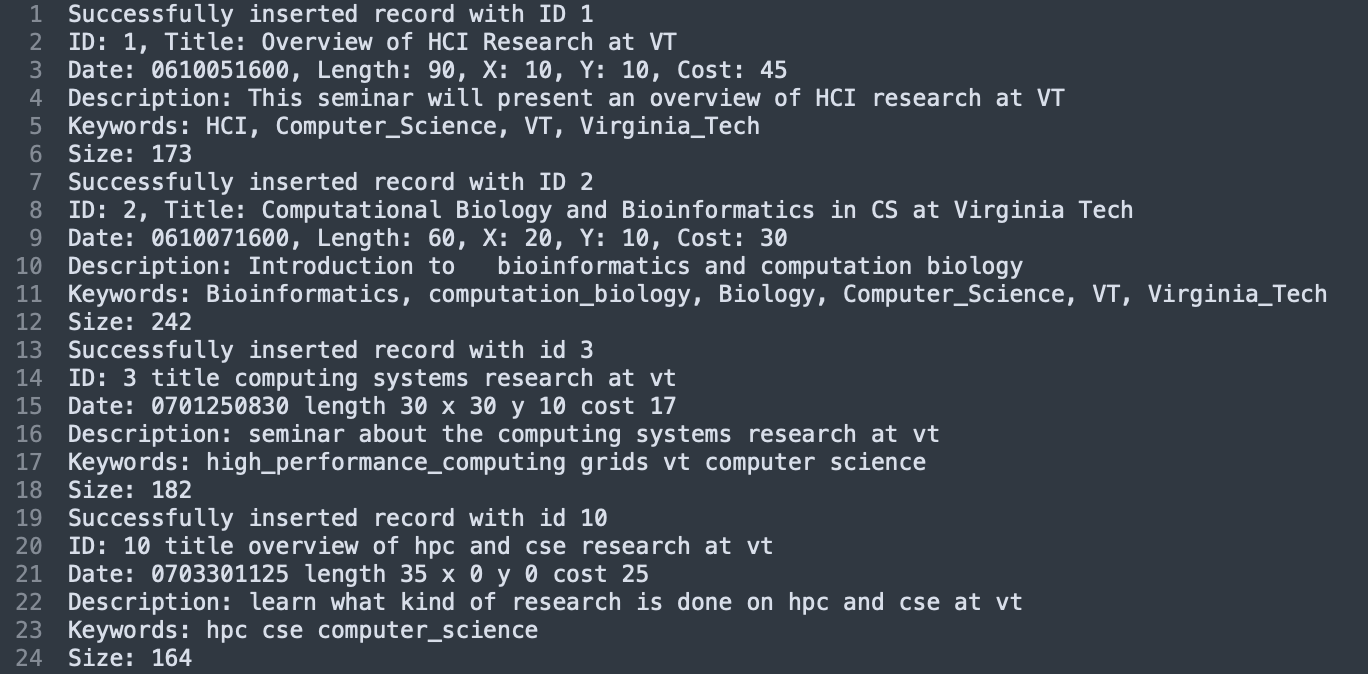
Takeaways Link to heading
- This program efficiently manages seminar records in memory, ensuring fast lookups (via hashing) and optimized memory usage (via dynamic block allocation/merging).
- Still, code up memory management related functionality is quite challenging and I am very glad that I gave it a try.